Bread Maker Reviews: Models Worth Buying
These bread maker reviews compare six machines by the features that shape daily use: loaf size, programs, controls and timing. Choose Cuisinart for a compact design, KBS for an automatic add-in dispenser, Zojirushi for dual heaters, or KITCHENARM for custom cycle control.
On this page (10 sections)
- What matters most in bread maker reviews?
- Which bread maker suits each baking style?
- How do you choose a loaf size?
- When are extra programs and custom controls useful?
- Which add-in feature fits your routine?
- What should you check before setting up a bread maker?
- How do you avoid common bread maker mistakes?
- How should you clean and care for a bread maker?
- How do you narrow a bread maker shortlist?
- Which bread maker should you choose?
These bread maker reviews compare six models by the features that affect everyday baking: loaf size, menu choices, timing and control. If you mostly want a reliable routine for basic bread, prioritize a suitable batch size and clear controls; if you want to adapt recipes, look for custom cycles.
The Cuisinart favors a compact footprint, the KBS Pro automates add-ins, and the Zojirushi uses dual heaters. The KITCHENARM gives you room to adjust cycle settings, while Hamilton Beach and Elite Gourmet offer a mix of everyday and specialty programs.
Compare the best bread machines for home bakers if you want a shorter shortlist.
What matters most in bread maker reviews?
The best bread maker for you is the one whose loaf capacity, useful settings and controls fit your routine. Start with what you plan to bake and how much bread you use, then check the machine’s footprint and convenience features.
A long menu can look appealing, but it matters only if you will use the extra options. A machine with the right settings and a manageable interface is often a better match than one with menus you rarely need.
| Your priority | What to compare |
|---|---|
| Smaller or larger batches | Available loaf sizes |
| Special recipes | Gluten-free, whole wheat, dough and other relevant menus |
| Flexible timing | Delay timer and keep-warm functions |
| Custom recipes | Whether cycle times or settings can be adjusted |
| Add-in convenience | Automatic dispenser or reminder beep |
| Counter fit | Outside dimensions and pan shape |
Start by listing the breads and doughs you make now, plus one or two recipes you hope to try. Then use our guide to what to look for in a bread machine to compare the features that matter for those recipes.
A small household may prefer a model that can bake a 1 lb loaf. Someone who regularly serves bread to a family may value a larger maximum size, while a baker who experiments with rye or gluten-free recipes may care more about the menu and cycle controls.
Which bread maker suits each baking style?
Each of these six bread makers has a clear use case. Match the listed features to your habits and counter space, and be selective about any feature you do not expect to use.
Cuisinart 12-Program 2 lb Bread Maker
The Cuisinart suits buyers who want a compact machine with several loaf sizes. Its vertical pan supports 1 lb, 1.5 lb and 2 lb loaves, while the LCD shows the selected cycle, options and countdown.
There are 12 menu programs, three crust colors and a 60-minute keep-warm cycle. Audible reminders provide a prompt during a cycle, and its menus include options for baked goods such as cake and pizza.
Choose the Cuisinart if counter space is tight and you want to change batch size without moving to a larger machine. Skip it if your priority is custom cycle programming or an automatic dispenser, since those are not among its listed features.
The machine measures 10.25 in deep, 13.25 in wide and 11.25 in high. Measure the spot where you expect to use it, including the clearance needed to open the lid, before making a decision.
KBS Pro 2.2 lb Bread Maker
The KBS Pro suits bakers who want an automatic add-in dispenser and more control over baking. It has 17 programs plus a custom setting, three loaf sizes up to 2.2 lb, and three crust colors.
Its ceramic pan and paddle, viewing window and touch panel round out the design. The 15-hour delay timer and 60-minute keep-warm function give you scheduling choices, and the included recipe book has 53 recipes.
Pick this machine if nuts, seeds or similar additions are part of your regular baking and you want the machine to handle that step. Skip it if you rarely use add-ins or prefer a shorter setup with fewer controls to learn.
At 9.76 in deep, 13.58 in wide and 12.21 in high, it is worth measuring both counter and cabinet space. Its larger 2.2 lb option is useful when a standard 2 lb loaf is not enough, but it may be more capacity than a small household needs.
Zojirushi Home Bakery Virtuoso Plus
The Zojirushi suits buyers who want dual heaters and specialty bread settings. Its heaters sit in the bottom and lid, and double kneading blades work the dough.
It makes a rectangular 2 lb loaf and includes settings for multigrain, whole wheat, rapid whole wheat, gluten-free, salt-free, sugar-free and vegan bread. Rapid courses can make white or whole wheat bread in 2 hours and 25 minutes.
Choose it if a rectangular loaf suits your needs and you expect to use its specialty courses. Skip it if you need variable loaf sizes, a compact width or custom cycle programming; this model makes one loaf size and measures 18 in wide.
For a closer look at the brand’s options, see Zojirushi bread machines compared. Check your counter width before choosing, since its footprint is wider than the other models in this guide.
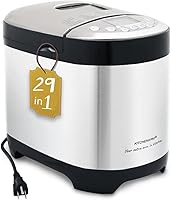
KITCHENARM 29-in-1 Bread Machine
The KITCHENARM suits bakers who want many menus and adjustable cycles. It has 29 automatic menus, a customizable HOME MADE menu, three loaf sizes and three crust colors.
The HOME MADE menu lets you adjust knead, rest, rise and bake times, and the machine can save settings for reuse. It also has a 15-hour delay timer, a 60-minute keep-warm function and alarms for add-ins or paddle removal.
Choose it if you like to adapt recipes and want to preserve your preferred settings. Skip it if a basic loaf is your main goal and you would rather select a simple preset than manage a broad menu.
The machine measures 14.2 in deep, 8.9 in wide and 12 in high. Its narrow width can suit a tight counter, but check the depth against the space available.
Hamilton Beach Digital Bread Maker
The Hamilton Beach suits buyers who want a digital display and an add-in reminder. It makes 1 lb, 1.5 lb or 2 lb loaves and has 14 settings, including gluten-free, dough, cake and jam.
Its express cycles are available for different loaf sizes, and the countdown display shows baking time. The keep-warm function runs for up to an hour after baking, while the pan and kneading paddle are PFAS-free and dishwasher safe.
Choose it if you are usually close by when the machine beeps and want to add ingredients yourself. Skip it if you want an automatic dispenser or adjustable cycle programming.
The machine measures 13.9 in deep, 11.4 in wide and 11.2 in high. If you plan to store it between uses, confirm you have room to move and lift it safely.
Elite Gourmet 2 lb Bread Maker
The Elite Gourmet suits buyers who want a broad preset menu with variable loaf sizes. Its 19 programs include gluten-free bread, pizza dough, cake, jam and yogurt.
It has a 15-hour delay timer and a 60-minute keep-warm function. The machine measures 9.45 in deep, 11.89 in wide and 13.98 in high, so check both its footprint and height against your counter or storage spot.
Choose it if its preset programs match your recipes and you want to switch between three batch sizes. Skip it if you want to program cycle-by-cycle timing; the KITCHENARM offers that level of adjustment.
How do you choose a loaf size?
Choose the smallest loaf size that meets your usual needs, with a larger option for days when you bake for more people. A smaller batch can reduce leftovers, while a larger loaf can mean fewer baking sessions.
The Cuisinart, KITCHENARM, Hamilton Beach and Elite Gourmet each offer 1 lb, 1.5 lb and 2 lb choices. KBS offers sizes up to 2.2 lb, while Zojirushi makes a 2 lb loaf.
Think about how often you eat bread and whether you freeze extra slices. If your household rarely finishes a large loaf while it is fresh, the smaller settings available on several models may be more useful than the largest capacity.
See our bread machine loaf size guide for more help matching capacity with your household. Also compare the machine’s dimensions: a higher loaf capacity does not automatically mean a wider machine, and a compact footprint does not tell you whether it will fit under your cabinets.
When are extra programs and custom controls useful?
Extra programs are useful when they match recipes you expect to make. If you bake mostly basic bread, focus on clear controls and the right loaf size before counting menus.
The KITCHENARM offers the most menu options in this group, along with a HOME MADE menu for adjusting cycle stages. The Cuisinart and Hamilton Beach offer fewer menus, but both include settings for more than basic bread.
Look for the names of the programs you need rather than assuming every machine handles a recipe the same way. Gluten-free bread, whole wheat, dough and cake settings are available on several models, while individual menus and control options differ.
If you want to understand what cycles do before buying, read bread machine settings explained. The explanation can help you decide whether a dough setting, rapid cycle or custom program will change how you use the machine.
Which add-in feature fits your routine?
An automatic dispenser suits you if you want the machine to add ingredients during baking. A beep suits you if you are usually nearby and would rather add them yourself.
The KBS Pro has an automatic dispenser. Hamilton Beach signals before the second kneading cycle, so you can add fruit, nuts, seeds or other ingredients at that point.
Consider how you use the machine during a typical bake. If you want to start a cycle and leave the kitchen, a reminder means you still need to return when it beeps; if you are nearby, it can be a simple way to manage add-ins without a dispenser.
What should you check before setting up a bread maker?
Before the first loaf, read the instruction manual and set the machine on a stable, level counter with space for the lid and air to circulate. Keep it away from the edge, water and heat sources.
Take out the pan and paddle, and make sure you understand how the pan locks into place and how the paddle attaches. Check that the controls, loaf sizes and crust choices are familiar before adding ingredients.
Use a recipe written for a bread machine, and measure each ingredient carefully. Bread baking depends on the balance of wet and dry ingredients, so avoid estimating flour, water, salt or yeast.
Add ingredients in the order recommended by the recipe and machine instructions. The order can vary by recipe, so do not assume one method works for every loaf.
If you plan to use a delay timer, follow the manual and recipe guidance, especially for ingredients that need refrigeration. The timer is useful for scheduling, but it does not make perishable ingredients safe to leave out longer than recommended.
For a first loaf, choose a basic recipe and a standard program before trying custom settings or multiple add-ins. That gives you a clear starting point for learning the control panel and understanding the machine’s cycle.
How do you avoid common bread maker mistakes?
Most early problems come from measuring errors, the wrong cycle or ingredients that do not suit the recipe. Keep your first few loaves simple and change one thing at a time.
- Measure ingredients with the units and method in the recipe. Too much liquid or flour can change how the dough forms and bakes.
- Use the recipe’s recommended flour and yeast. Different ingredients can behave differently, so substitutions may need a recipe designed for them.
- Select the correct loaf size and cycle before pressing start. The same ingredient amounts do not suit every machine or loaf setting.
- Wait for the add-in signal when your machine uses one. Adding ingredients too early can affect how they are mixed through the dough.
- Keep the lid closed during the cycle unless the manual says otherwise. Opening it can affect the baking process.
- Let the loaf cool before slicing. Cutting into hot bread can compress the crumb and make slices harder to handle.
- Remove the pan carefully after the cycle. It and the loaf may be hot.
If your loaf collapses, the cause can relate to ingredients, measurement or the recipe’s fit with the selected cycle. Use our guide to why bread machine loaves collapse to troubleshoot likely causes.
How should you clean and care for a bread maker?
Care starts with letting the machine cool and following the cleaning instructions for its pan and paddle. Avoid immersing the machine body in water.
Unplug the machine before cleaning. Remove the pan and paddle when cool enough to handle, and wipe crumbs or flour from the interior with a soft, damp cloth.
The care instructions differ by model. The Cuisinart and Zojirushi call for hand washing, while Hamilton Beach says its pan and paddle are dishwasher safe; check the manual for the exact parts and method before cleaning.
Avoid metal utensils or abrasive scrubbers on nonstick surfaces. If a paddle sticks, let the pan soak as directed in its manual, then clean it gently rather than forcing it loose.
Dry removable parts before storing them. For more details, follow how to clean a bread machine pan and paddle.
How do you narrow a bread maker shortlist?
Start with three filters: the recipes you make, the loaf size you need and the counter space you have. Compare convenience features only after those needs are clear.
- Write down the bread and dough settings you expect to use.
- Choose the loaf sizes that match your usual batch.
- Measure your counter and storage space.
- Decide whether custom controls, an automatic dispenser or an add-in reminder would help.
- Compare the timer, keep-warm and display features on the remaining options.
If your budget is the main filter, use our best bread machines under 200 dollars guide to compare models in that group. Confirm the exact model details before buying, since product information can change.
Which bread maker should you choose?
Choose the Cuisinart for a compact design and three loaf sizes, the KBS Pro for an automatic dispenser, the Zojirushi for dual heaters and specialty courses, or the KITCHENARM for custom cycles. These bread maker reviews point to different strengths, so start with the feature you will use most.
Consider Hamilton Beach if you want a digital display and reminder beep, or Elite Gourmet if its preset menus and loaf sizes fit your recipes. If you are still comparing everyday options, begin with the best bread machines for home bakers.
Frequently asked questions
What should I compare in bread maker reviews?
Compare the loaf sizes, programs, controls, timer options and dimensions with the way you bake. A larger menu count does not automatically make a machine the better fit; identify the bread styles and dough cycles you expect to use, then see which models offer those features in a size that suits your household.
Are more programs better in a bread maker?
More programs help when they match recipes you plan to make, such as gluten-free bread, dough or jam. If you mainly bake a basic loaf, a clear control panel and the right loaf size may matter more than a long menu.
Custom cycle controls are useful when you want to adjust recipes.
What loaf size should I choose?
Choose a loaf size based on how much bread you can use while it is fresh. The machines in this guide offer options from 1 lb to 2.2 lb, though the exact choices vary.
A model with more than one size lets you bake a smaller batch most days and a larger one when needed.
Do bread makers have delay timers?
Several machines in this guide have delay timers that let you schedule a cycle to finish later. Follow the recipe and machine instructions when scheduling a loaf, especially when ingredients need refrigeration.
Avoid leaving perishable ingredients at room temperature longer than recommended.
Can a bread maker make dough?
Yes, several models include dough settings for recipes such as pizza dough. A dough cycle mixes and kneads the ingredients, while you shape and bake the dough separately.
Check the menu names before you buy, since dough options vary and some are designed for specific recipes.